
NPI Structure for Multi-Location Audiology Clinics

By: Kellye St Claire, MHA
While you’re here, check out…
NPI 101: Everything Audiologists Need to Know
October 18, 2024
Read More
ul > .bdt-post-block-item; delay: 350;”>
-

Medicare & Audiology Questions Answered
October 7, 2024
-

Skating Too Close
May 29, 2024
-
Oticon Chooses Value Over Volume
April 29, 2024
-

Data is Your Greatest Strategic Asset
February 27, 2024
Best Practices for Streamlined Billing and Compliance
If you own or manage a multi-location audiology practice, understanding the NPI structure for multi-location audiology clinics is critical to ensure smooth billing and compliance.
NPIs impact every aspect of healthcare administration, from claims processing and reimbursement rates to meeting insurance contract requirements.
If you missed my previous post on NPI 101s, let’s catch you up to speed with the two different types of NPI numbers.
Type 1: Type 1 NPIs are assigned to individual healthcare providers, including audiologists, physicians, nurse practitioners, and any licensed individual providing healthcare services.
Type 2: Type 2 NPIs are designated for healthcare organizations, such as group practices, clinics, hospitals, and audiology practices that bill as an entity rather than as an individual.
Let’s explore how to structure NPIs for your audiology clinics effectively, helping you:
-
- Streamline billing
- Improve reimbursement
- Ensure compliance across all locations

NPI Basics: Parent, Group, and Subpart NPIs
When managing a multi-location audiology clinic, there are three types of NPIs you’ll likely work with. This structure is essential if your locations have distinct service areas or billing needs, as it lets each clinic bill independently, based on local rates or payer requirements.
Parent NPI
Type 2 NPI
This is the primary NPI for your organization. This Type 2 NPI represents the entire practice as a single legal entity, allowing for centralized identification in billing and administrative tasks.
Regional NPI
Type 2 NPI
For large practices with multiple clinics in one state, a group NPI utilized by all clinics within that state can simplify billing. By using this Type 2 NPI, all clinics within that state submit claims under a single identifier, which streamlines processes for payers.
Subpart NPI
Type 2 NPI
Each individual clinic location may have its own Type 2 NPI, known as a subpart NPI. This structure is essential if your locations have distinct service areas or billing needs, as it lets each clinic bill independently, based on local rates or payer requirements.
Deciding Between Regional NPI and Subpart NPIs
Selecting the best NPI structure for multi-location audiology clinics depends on your goals, payers, and contract requirements.
Here are some scenarios to consider:
1. Consistency with a Group NPI
Using a Regional/State NPI means all clinics in a region/state bill under one number. This consistency can reduce administrative work and speed up claims processing. However, payers may expect all clinics in the region/state to use the same billing method.
2. Flexibility with Subpart NPIs
Subpart NPIs allow each clinic to bill separately. This setup is ideal if your clinics offer different services or have unique reimbursement rates. Each location maintains billing autonomy, which makes it easier to meet payer expectations, especially for claims requiring exact service locations.
Commercial Insurance Contracts and NPI Strategy

Commercial contracts often outline specific billing requirements, which are essential for multi-location audiology practices.
-
Unified or Regional Billing
Some contracts require all locations in a state to bill under one group NPI. Inconsistent billing could violate contract terms or cause denials.
-
Location-Based Credentialing
Whether you use group or subpart NPIs, each clinic and audiologist must be credentialed. This ensures providers meet payer requirements and receive reimbursement.
-
Regional Fee Schedules
Some states have unique cost structures. Using subpart NPIs allows for location-specific reimbursement rates, which can better match local costs.
Claims Processing and Reimbursement Effects

NPI structure directly affects your financial outcomes.
Here’s what to consider:
-
Streamlined Claims with Consistent Billing
Using a group NPI across a region speeds up claims. Yet, mixing group and subpart NPIs within a region may disrupt this flow, leading to denials.
-
Revenue Tracking and Compliance
Subpart NPIs allow tracking revenue by location. This makes it easier to monitor performance, manage audits, and identify any discrepancies.
Practical Example: The “Hear Me Out” Audiology Network
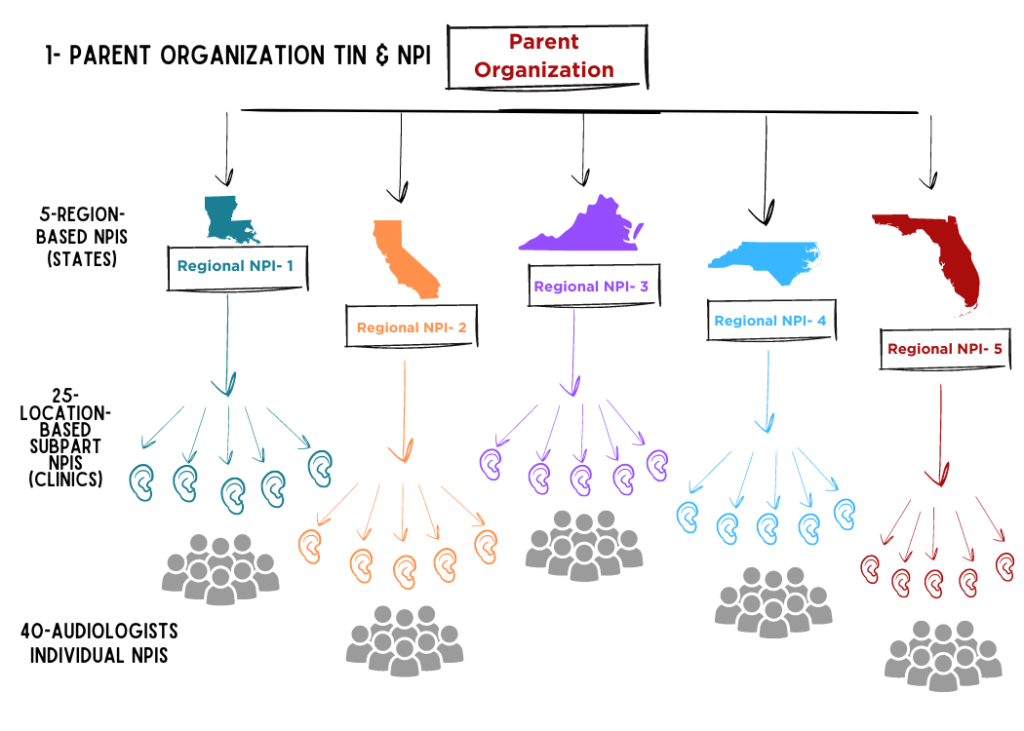
To illustrate these strategies, let’s consider the example of Hear Me Out, our fictional audiology network with 20 clinics in five states:
- Louisiana
- Florida
- California
- Virginia
- North Carolina.
Hear Me Out, the parent company has a Type 2 Group NPI number.
Each state is structured as a regional Type 2 Group under the Hear Me Out parent NPI.
Each individual clinic (Hearing Center 1, Hearing Center 2, etc.) also has a subpart Type 2 NPI to maintain operational flexibility and cater to location-specific requirements.
Example Breakdown for Hear Me Out
State-Level Flexibility: Hear Me Out uses group NPIs at the state level (e.g., Hear Me Out – Florida Region) for consistency in claims processing, especially for commercial payers who prefer regional billing.
Clinic-Level Autonomy: Each clinic, such as “Hear Me Out – Hearing Center 1, Louisiana,” retains a subpart NPI to allow flexibility in billing specific services or meeting distinct payer requirements. This is particularly helpful in states like California, where higher local costs might necessitate tailored reimbursement rates.
Insurance Contract Adherence: Hear Me Out’s administrative team ensures both group and subpart NPIs align with commercial contract terms to avoid claim denials. They check with each payer to determine whether mixed billing (using both group and subpart NPIs) is allowed or if uniform billing is preferred.
This structure gives Hear Me Out operational flexibility while meeting compliance standards. In states with consistent billing requirements, the clinics use group NPIs. For states with higher costs or reimbursement needs, subpart NPIs are more effective.
Key Takeaways for Structuring NPIs in Multi-Location Audiology Practices
-
Confirm with Payers
Before mixing group and subpart NPIs within a region, confirm with payers to avoid denials. Some insurers might expect all clinics to follow a consistent NPI approach within a state.
-
Balance Flexibility and Consistency
While subpart NPIs allow for more flexibility, a group NPI can simplify billing processes and might be preferred by some payers. Evaluate which structure best aligns with your operational goals and payer requirements.
-
Review Contracts Carefully
Payer contracts often dictate how NPIs should be structured, especially if services or reimbursement rates differ by location. Ensure your NPI setup complies with contract terms to avoid compliance issues.
-
Invest in Robust Systems
For organizations using a mix of group and subpart NPIs, invest in a practice management system that can handle both structures, ensuring accurate claims submission, revenue tracking, and compliance. Effective NPI use can bring organization, financial clarity, and smoother claims processing to a multi-location audiology practice.
By understanding the roles of group, subpart, and parent NPIs, and aligning with payer and contract expectations, your practice can streamline operations and optimize reimbursements.
Final Thoughts on NPI and Compliance
As healthcare administration becomes more complex, especially in audiology, understanding NPI structures is essential. With the right setup, your practice can ensure compliance, improve billing, and focus on delivering quality care to patients.
Sources
FEDERAL REGISTER
Department of Health and Human Services